
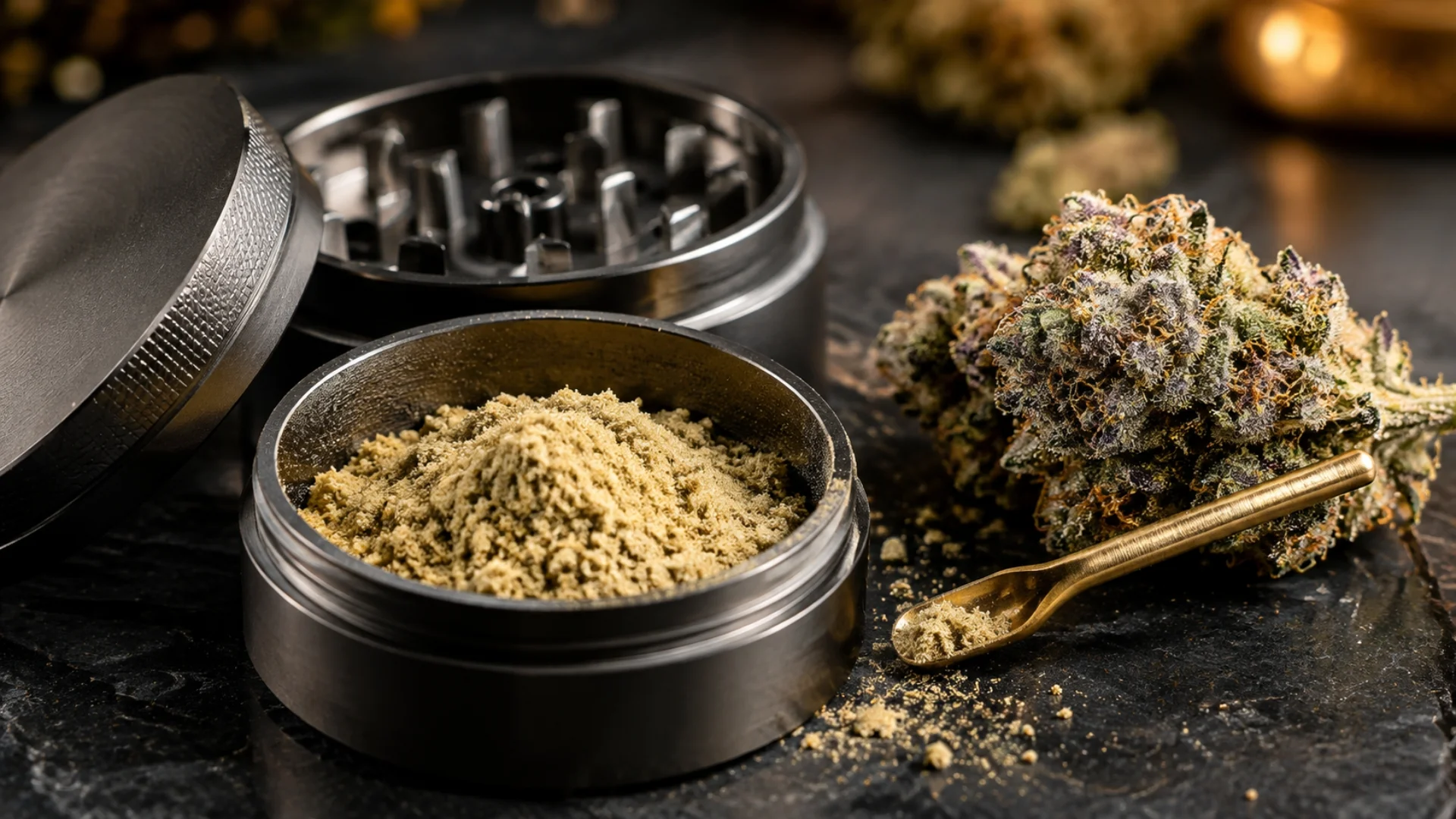
What Is Kief? The Complete Guide to Cannabis Trichomes, Potency, and Uses
If you use a three-piece or four-piece grinder, you have likely noticed a pale, crystalline powder accumulating in the bottom compartment beneath the mesh screen. That concentrated powder is kief.
Far from being discarded plant dust, kief contains the highest concentration of active cannabinoids and aromatic terpenes found anywhere on the cannabis plant.
- Botanical Identity: Kief consists of detached glandular trichome heads mechanically separated from cured cannabis flowers and sugar leaves.
- Potency Range: Typical grinder-collected kief tests between 35% and 50% total THC, while commercially refined dry sift can exceed 60%.
- Primary Function: Topping bowls, infusing joints, pressing into traditional hashish, extracting solventless rosin, or infusing edibles after decarboxylation.
- Optimal Handling: Burning pure kief directly often liquefies the resin and clogs hardware; pairing it between layers of ground flower preserves its flavor and potency.
What Is Kief Made Of? Botanical Anatomy and Trichome Science
The term kief originates from the Arabic word kayf, translating loosely to “well-being,” “pleasure,” or “contentment.” In cannabis culture, it describes the collection of resin glands that separate from the plant when cured buds are handled or ground.
To understand kief, one must examine the microscopic anatomy of Cannabis sativa L. The glistening crystals covering mature female cannabis flowers are glandular trichomes. In nature, these structures serve as an evolutionary defense mechanism, producing bitter secondary metabolites, pungent aromas, and sticky physical barriers to deter insect herbivores and protect developing seeds from damaging ultraviolet radiation.

Within the secretory disc cells at the base of the capitate-stalked head, the plant synthesizes cannabigerolic acid (CBGA). Specialized enzymes convert CBGA into precursor acids, including tetrahydrocannabinolic acid (THCA) and cannabidiolic acid (CBDA).
When cannabis is properly dried and cured, the junction between the stalk and the secretory head—known as the abscission zone—becomes brittle. Mechanical friction fractures this abscission layer, releasing the resin head intact. A collection of these detached heads constitutes pure kief.
The Kief Quality and Color Spectrum: How to Spot Pure Resin
Not all kief carries the same chemical purity. The visual appearance and texture of collected sift provide immediate indicators of cannabinoid concentration and filtration efficiency.
| Color & Visual Appearance | Primary Composition | Estimated Purity Tier | Sensory & Burn Characteristics |
|---|---|---|---|
| Pale Blonde / Off-White / Light Amber | Intact glandular heads; minimal cellular debris | High (50%–70% Total Cannabinoids) | Smooth draw, rich terpene flavor, bubbles cleanly under gentle flame |
| Golden Yellow / Light Tan | Standard grinder sift; small fraction of broken stalks | Moderate-High (35%–50% Total Cannabinoids) | Clean herbal burn, aromatic, slight pepper finish on the palate |
| Dull Olive / Chalky Green | Pulverized leaf bracts, stalks, and chlorophyll dust | Low-Moderate (20%–30% Total Cannabinoids) | Harsh smoke, hot combustion, bitter vegetable aftertaste |
A bright or olive-green hue indicates that plant matter has contaminated the collection. When cannabis is ground excessively or pressed with excessive force against a grinder screen, brittle sugar leaves break into micro-fragments that fall into the collection chamber. Chlorophyll adds harshness to the smoke and dilutes potency.
In contrast, high-grade kief resembles clean beach sand. It feels slightly sticky when rolled between the fingertips because the waxy cuticular sheaths of the trichomes yield to body warmth.
Micron Ratings: How Screen Size Dictates Sift Purity
Industrial sifting operations employ precise mesh screens rated by micron aperture (μm). Screens ranging from 73 to 120 microns allow mature capitate-stalked heads to drop through while excluding stalk fibers and leaf tissue. Grinders with standard stainless-steel screens typically filter around 100 to 140 microns, which provides a functional balance between accumulation speed and sift cleanliness.
How Strong Is Kief? Potency Compared to Flower and Concentrates
Cannabinoid potency depends on the ratio of active resin to inert plant cellulose. Standard cured cannabis flower generally tests between 15% and 30% total THC. Because flower contains structural stems, calyx leaves, and moisture, its potency is naturally limited by total mass.
Kief strips away much of that fibrous material. By isolating the glandular heads where cannabinoids are produced, mechanical sift achieves substantially higher potency by weight. Peer-reviewed pharmacological literature characterizes kief and uncompressed dry resin within an ecologically verified potency bracket of 30% to 50% total THC, with clean sift reaching up to 60% or higher.
| Cannabis Product Format | Extraction / Processing Technique | Dominant Physical Form | Typical Total THC Bracket | Onset & Duration Profile |
|---|---|---|---|---|
| Cured Cannabis Flower | Drying, curing, and mechanical trimming | Whole dried inflorescence | 15% – 28% | Inhaled: 1–3 min onset; 1–3 hour duration |
| Grinder-Collected Kief | Agitation over internal metal mesh screen | Granular crystalline powder | 30% – 45% | Inhaled: 1–2 min onset; 2–4 hour duration |
| Commercial Dry Sift | Stacked vibratory screens (73μm–105μm) | Fine blonde powder | 50% – 65% | Inhaled: Rapid onset; potent, sustained peak |
| Traditional Pressed Hash | Mechanical compression and mild heat | Dense, cohesive dark slab | 35% – 55% | Inhaled: Slow, even burn; mellow body load |
| Solventless Live Rosin | Pneumatic heat and pressure on ice water hash | Translucent, terpene-rich batter | 65% – 85% | Inhaled: Near-instantaneous onset; heavy cerebral effect |
While kief provides higher cannabinoid density than raw flower, it differs from solvent-based extracts such as butane hash oil (BHO) shatter, live resin, or distillates, which frequently test above 80% to 90% THC.
Kief remains a mechanically separated, solventless product that preserves the original natural balance of cannabinoids and volatile terpenes—such as β-myrcene, limonene, and β-caryophyllene—present in the source cultivar.
What to Do with Kief: 5 Ways to Consume It Safely and Efficiently
The concentrated nature of kief requires thoughtful consumption. Because it lacks structural plant fibers, applying a direct flame causes loose kief to liquefy, pull through downstems, or scorch into an acrid smoke.
1.Crowning a Bowl: The Sandwich Technique
Crowning involves topping a pipe or bong bowl with a layer of kief. If you ignite kief directly with a lighter, you will incinerate delicate monoterpenes before they can be inhaled.
To avoid this, employ the sandwich method:
Pack the bottom half of your bowl with medium-ground cured flower to create a supportive bed.
Deposit a small pinch of kief (approximately 0.05 to 0.10 grams) across the center.
Cover the kief with another light layer of ground flower.
Apply flame gently to the outer rim of the bowl (“cornering” the hit).
The burning flower creates a heat zone that vaporizes the kief underneath without directly torching the resin heads.

2. Twaxing Joints and Pre-Rolls
Twaxing refers to infusing a joint, blunt, or pre-roll with concentrated cannabis. You can disperse loose kief evenly throughout your ground flower before rolling, which ensures a uniform, slow burn.
Alternatively, if you are working with professionally crafted pre-rolls—such as the artisanal house selections available on the curated cannabis menu at WeedValley—you can lightly coat the exterior. Moisten the outer paper with a thin layer of cannabis concentrate or natural gum, then roll the pre-roll through your kief collection. This creates an infused smoke that burns slowly and delivers an elevated terpene experience.
3. Vaping Kief in Dry Herb Devices
Using a dry herb vaporizer is one of the most flavor-focused ways to consume kief, as it eliminates combustion byproducts entirely. However, loading loose kief directly into a dry herb chamber can ruin your device.
As the resin heads heat up, they melt into a runny oil that can seep down through the heating chamber’s air intake ports, causing electrical shorts or clogged conduction screens.
To vape kief safely:
- Place a small cushion of ground flower or degummed organic vape cotton over the bottom screen of the chamber.
- Add a conservative layer of kief in the center.
- Top with additional flower before closing the chamber.
- Set your vaporizer between 365°F and 390°F (185°C–199°C) to volatilize cannabinoids and terpenes without scorching the material.
4. Compacting Kief Discs and Pucks
If you collect substantial quantities of sift, handling loose powder can become messy. Using an inexpensive handheld screw-down pollen press compresses loose kief into solid, coin-sized discs or pucks.
Mechanical pressure forces the trichome cuticles to bond, creating a firm pellet that resists wind, stores compactly, and can be sliced into small pieces for bowl packing or pipe use.
5. Blending Kief into Morning Coffee or Tea
Because kief melts easily, some consumers stir it directly into hot coffee or tea.
However, raw kief contains non-intoxicating THCA rather than active Δ9-THC, meaning hot beverages will only produce mild effects unless the kief is decarboxylated beforehand and paired with a dietary fat (such as whole milk, heavy cream, or butter) to facilitate cannabinoid absorption.
Can You Dab Kief Directly?
A common question among concentrate users is whether loose kief can be dabbed off a red-hot quartz banger or electronic rig.
The short answer is no; you should avoid dabbing unrefined kief.
Even finely sifted kief contains trace amounts of plant bracts, cellulose fibers, and trichome stalks. While whole cannabis extracts (like BHO, live resin, or distilled oils) contain only extracted lipids and cannabinoids that vaporize cleanly, raw plant material does not melt away completely.
Placing raw kief onto a 450°F–550°F quartz nail instantly scorches those organic fibers. The plant debris bakes into the microscopic pores of the quartz surface—a process known as “chazzing”—ruining the banger and producing a harsh, acrid smoke that irritates the throat and lungs. To dab trichomes safely, they must first be refined into solventless rosin using heat and physical pressure, or filtered into full-melt bubble hash.
Upgrading Your Kief: Hashish, Rosin, and Moon Rocks
Rather than consuming kief as a loose powder, you can process it at home into traditional, more shelf-stable concentrates.
What Is the Difference Between Kief and Hash?
While kief and hashish share the same raw material—cannabis trichomes—their physical structures and combustion properties differ substantially. Kief is the loose, uncompressed collection of resin heads. Hashish (hash) is created by applying controlled mechanical pressure and heat to kief, rupturing the outer resin membranes and fusing them into a cohesive, oily mass.
This compression initiates several transformations:
- Oxidative Maturation: The exterior of pressed hash darkens into a rich brown or near-black shell that shields internal cannabinoids from light and atmospheric degradation, giving it a longer shelf life than loose kief.
- Burn Regulation: Loose kief flares up quickly; pressed hash smolders gradually and consistently, making it ideal for extended pipe sessions or rolling into thin snake-like rolls for joints.
- Flavor Deepening: Compressing trichomes releases trapped monoterpenes and sesquiterpenes, yielding the earthy, spicy profile characteristic of traditional hash.
Pressing Solventless Rosin at Home
Rosin extraction uses heat and mechanical pressure to squeeze out concentrated resin without chemical solvents like butane, propane, or ethanol. While flower rosin usually yields 15% to 22% oil by weight, pressing pure kief can deliver yields ranging from 50% to 75%.
To press kief into rosin:
- Pack your dry sift into a 25-micron or 37-micron nylon filter pouch to keep fine particulate out of the finished oil.
- Enclose the filter pouch inside clean, unbleached parchment paper.
- Set your rosin press plates between 170°F and 195°F (77°C–90°C). Lower temperatures protect delicate monoterpenes and preserve a lighter color.
- Apply slow, steady pressure over 90 to 120 seconds. The liquefied resin will seep through the mesh, pooling on the parchment as a golden, aromatic rosin that can be dabbed or loaded into vaporizers.

Creating Homemade Moon Rocks
Moon rocks are dense, multi-layered cannabis treats. They are constructed by taking a tight flower nugget, coating it with warm hash oil, distillate, or live resin, and rolling it through loose kief until completely covered.
The resulting product looks like a miniature asteroid, packing an intense punch that burns slowly and tests well above 50% THC. Break moon rocks apart with your fingers or a knife rather than a grinder to avoid gumming up your teeth and screens.
How to Decarboxylate Kief for Potent Homemade Edibles
Consuming raw kief will not generate meaningful psychoactive effects because cannabinoids develop in carboxylated acid forms, primarily THCA. The extra carboxylic acid group (-COOH) attached to the molecule prevents it from binding effectively with human cannabinoid 1 (CB1) receptors in the brain.
When you smoke or vape, thermal energy instantly removes this acid group as carbon dioxide (CO2), converting inactive THCA into active Δ9-THC:
THCA → Δ9-THC + CO2↑
For homemade edibles, tinctures, or capsules, you must activate your kief using oven decarboxylation before blending it with cooking oils or butter. Because kief lacks the dense, insulating moisture of whole flower buds, it decarboxylates more quickly and evenly. Careful temperature control is essential: excessive heat degrades Δ9-THC into cannabinol (CBN), which can cause grogginess and heavy sedation.
| Desired End-Use Cannabinoid | Optimal Oven Temp | Duration | Target Moisture / Color Indicator | Primary Chemical Conversion |
|---|---|---|---|---|
| Maximized Delta-9-THC | 240°F (115°C) | 30 – 35 minutes | Light golden amber, toasted nutty aroma | Rapid conversion of THCA to THC; minimal CBN |
| Maximized CBD | 240°F (115°C) | 45 – 55 minutes | Medium amber, warm herbal scent | Slower acid conversion required for CBDA to CBD |
| Elevated CBN (Sleep Formulations) | 260°F (127°C) | 60 – 75 minutes | Deep toasted brown, roasted earthy tones | Thermal oxidation of active THC into sedating CBN |
Once cooled, stir the activated kief directly into melted coconut oil, clarified butter (ghee), or high-proof food-grade alcohol. Because kief dissolves easily into warm fats without leaving large leaf pieces behind, you do not need to perform messy cheesecloth filtering, preserving your full yield for baked goods, savory dressings, or gel capsules.
Grinder Maintenance: How to Clean a Clogged Kief Screen
After several months of processing cured flower, your grinder’s kief collection will slow down. This happens because sticky resin builds up in the mesh openings, creating an impermeable barrier.
Instead of aggressively poking the screen with pins—which can puncture the wire and let green leaf matter into your collection—use these proven restoration techniques:
- The Freezer Technique: Cold temperatures cause cannabis resin to contract and turn glass-brittle. Disassemble your grinder, place a sanitized nickel or quarter in the flower chamber above the mesh, and set the parts in your freezer for 30 minutes. Remove the unit and shake it firmly; the cold coin dislodges frozen trichomes from the wire grid and drops them into the lower tray without water or chemicals.
- The Isopropyl Alcohol Bath: For heavy, baked-on buildup, place the empty metal screen compartment in a shallow glass dish of 91% or 99% isopropyl alcohol for 15 to 20 minutes. Lightly scrub the mesh with a soft toothbrush to clear out stubborn debris. Rinse the section thoroughly under hot running water and allow it to dry completely before reassembly. (Note: Only use alcohol on metal grinders; avoid soaking acrylic or painted plastic units, as solvents can degrade the material.)
Choosing Resin-Dense Strains for Maximum Sift Yields
Not all cannabis strains drop trichomes in equal measure. Genetic lineage heavily influences the density, size, and stalk brittleness of glandular resin heads. Cultivars developed from heavy Afghani, Kush, and Cookies backgrounds produce dense, clustered capitate-stalked heads that separate easily during curing and grinding.
When looking to build your kief reserves, select whole flowers characterized by heavy frost coverage. For instance, frosty selections like the Tiger Breath strain—a potent cross of Mendo Breath and Sunset Sherbet—produce dense resin carpets with large glandular heads that shed cleanly across collection screens. Pairing high-resin flower with consistent grinder maintenance ensures a steady supply of golden dry sift.
Navigating the Cannabis Landscape in Washington, DC
Whether you are collecting kief at home or looking for pre-infused items, it is important to understand local regulations in the District of Columbia. Cannabis rules in Washington, DC differ significantly from those in neighboring Maryland or Virginia.
ABCA Regulations and Safe Access
Washington, DC’s commercial cannabis market is governed by the Alcoholic Beverage and Cannabis Administration (ABCA) under the Medical Cannabis Amendment Act. While Initiative 71 originally permitted gifting between adults, the District has transitioned away from the gray-market storefront model. ABCA and the Metropolitan Police Department have closed over 100 unlicensed storefronts, establishing licensed dispensaries and registered delivery providers as the clear, compliant source for lab-tested products.
Accessing the licensed market is straightforward:
- DC Residents (21+): You can self-certify for a patient registration online through the ABCA portal without visiting a doctor, receiving a digital pass valid for shopping immediately.
- Out-of-State Visitors: DC recognizes medical cannabis registrations from other US states, and temporary visitor passes can be secured directly through the ABCA system.
Federal Jurisdictional Boundaries
Over 20% of the land within the District of Columbia is federal property. Local cannabis laws apply only on District land and inside private properties where building rules permit. Possessing or consuming cannabis is strictly prohibited on federal property, including:
- The National Mall, surrounding monuments, and the US Capitol Grounds.
- Rock Creek Park and federal riverfront reservations.
- The center circular park inside Dupont Circle (administered by the National Park Service).
- Public housing units and federal administrative complexes.

Always store your products in sealed containers during transport, and consume only in private residences or permitted outdoor areas.
Fast, Compliant Delivery Across DC Neighborhoods
If you prefer to bypass manual sifting and rolling, professional alternatives are readily accessible.
Operating from our primary fulfillment center at 1201 Half Street SE (2nd Floor) in the Navy Yard corridor, the WeedValley dispensary provides fast, discreet service across the District. Because our physical retail location is undergoing renovations to upgrade the customer shopping area, walk-in visits are currently paused. All operations are dedicated to curbside pickup and same-day delivery, bringing orders directly to your door in 30 to 40 minutes.
Whether you need infused options delivered to a historic rowhouse in Georgetown, an apartment along 14th Street in Logan Circle, or a residence in Adams Morgan, scheduling fast, compliant weed delivery in DC provides access to fresh, laboratory-tested cannabis without leaving home.
Frequently Asked Questions (FAQs)
Q : What is kief?
A : Kief refers to the collection of loose glandular trichome heads that have mechanically detached from cured cannabis flowers and sugar leaves. It contains the plant’s highest natural concentration of cannabinoids (including THCA) and aromatic terpenes. While it looks like a fine, golden dust, kief is not plant pollen; it is the resin-producing factory of the cannabis plant.
Q : How potent is kief compared to regular flower?
A : Kief is significantly stronger than cured cannabis bud. Whole cured flower typically tests between 15% and 28% total THC, whereas grinder-sifted kief averages 35% to 50% THC. Refined commercial dry sifts that exclude stalk fragments can reach 60% or more, delivering roughly two to three times the potency of standard flower by volume.
Q : Can you smoke kief by itself?
A : While you can technically smoke pure kief, it is inefficient and usually results in wasted material. Without plant cellulose to regulate airflow, loose kief melts into a hot, viscous puddle under direct flame. This can clog pipe screens, pull molten oil through the downstem, and produce a hot, harsh smoke. For the best experience, layer kief between ground flower using the “sandwich method” in a bowl or disperse it evenly inside a rolled joint.
Q : What is the difference between kief and hash?
A : Kief is the raw, loose powder of detached trichome heads. Hashish (hash) is produced by applying heat and physical compression to kief, which ruptures the outer resin glands and binds them into a dense, solid brick or pliable slab. This heat and pressure slightly decarboxylates the resin, alters the flavor profile, and produces a slower, more even burn than loose powder.
Q : What color should high-quality kief be?
A : High-quality kief displays a sandy blonde, pale yellow, or light amber appearance. If your kief has a dark olive or green tint, it contains excess chlorophyll and crushed leaf matter caused by overly vigorous grinding or a screen with overly coarse mesh. Clean, well-sifted kief should look like fine sand and feel slightly sticky when warm.
Elevate Your DC Cannabis Experience with WeedValley
Collecting kief takes patience, and building up enough sift for pressing or culinary infusions can take weeks of steady grinding. If you are looking for immediate flavor and potency without the wait, infused products provide a convenient alternative.
Ready-to-smoke options like our Gelato Mix pre-rolls offer balanced, terpene-rich experiences made with premium cured flower. Whether you want to explore new cultivars or restock your home stash, check out the curated cannabis menu at WeedValley to order online. Take advantage of prompt curbside pickup or enjoy same-day residential delivery anywhere in Washington, DC—arriving at your door in 30 to 40 minutes.